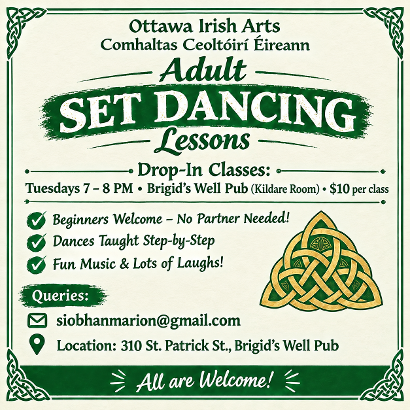
Ottawa Irish Arts holds Irish social dances (ceili, prononced like 'kaylee', accent on 'kay') where people come together and dance to live Irish traditional music. These ceilis are held in our 'dance season' between the months of September to April, though some months may be skipped. 'Regular' ceilis are held in the Kildare Room, downstairs, next to Brigid's Well Pub (see Main page Map). In March we have a huge ceili (up to about 300 people) upstairs in the old church.
To have a real Irish experience, come to a ceili! You don't need any experience, our events are very beginner friendly. If you don't come with a partner, no worries, it's very common, so just show up, and you'll find willing partners. The Main page will have links to Upcoming Events.
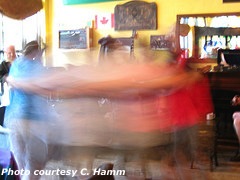
There are two main types of dance at our ceilis: Ceili Dances and Set Dances. Ceili Dances are more simple and contain a lot of repetition, so once you learn the pattern, you're good! Set Dances are more complex, and the easiset way to describe them to a newcomer is Irish 'square dancing' (with great Irish music), where 4 couples arranged in a square, 2 per side, face each other in pairs and execute particular moves and motions over a suite of dance styles (jigs, polkas, etc.). Learn more about Set Dancing, below. Ottawa Irish Arts teaches Set Dancing throughout the main 'dance season' with a most capable, patient, and enthusiastic instructor.
Irish Set Dancing
What is Set Dancing?
Irish set dancing, also referred to as "country set dancing", is a form of social dancing which has been popular in Ireland for over 150 years. These dances are based on French quadrilles (which were brought to Ireland by the British army in the nineteenth century), that were adapted by the Irish by integrating their sean-nós (old style) steps and Irish music.
The distinguishing characteristics of Irish set dancing is that it is danced in square "sets" of four couples (eight people), and consist of several "figures," frequently repeated throughout the set. These "sets" are danced by people in a formation similar to that of American square dancing. Each part of the set dance (figure) is danced to a music tempo, mostly reels, jigs, polkas, hornpipes and slides.
In set dancing there is less emphasis on footwork and more on the figures (the formation/movements of the dancers within the "set"). The basic footwork can be described as a low, ‘sliding’ movement. There are many different styles, from basic steps to very elaborately embellished steps.
Another Irish social dance is ceili dancing. This is a different, separate repertoire of dances which are commonly danced in Northern Ireland, England, America and Australia, but uncommon in the south of Ireland. The dances are in many forms, for couples or threesomes, in lines, squares and circles, including several in four-couple sets.
Dance notes/books
An excellent book describing the history of set dancing, the steps, the terminology and 64 of the most commonly danced sets is "Toss the Feathers" by Pat Murphy, published by Mercier Press.
Here you can link to Joe O'Hara' s "Study Notes for 80 Sets and 11 Figure Dances."
Contains: Set Dance Glossary
Videos of dances
The troupe of the Moscow Irish Folkdance Club has made superb recordings of two of the most common dances played at our Ottawa Branch ceilis, the Antrim Square and The Clare Dancers. Check each video and practice if you wish so you can dance them at the next ceili.
Antrim Square, Fig 1 (YouTube)
A very good resource to view dances like the Kilfenora, Cashel, Claddagh sets, and others, is Mike Didkovsky's YouTube Channel for the Moscow Irish Folkdance Club.
Videos of dance steps
If you are curious about the types of steps used in set dancing, here is an example on how to do an Irish reel step: This is a 4 part reel step for set dancing - (1) left heel; (2) right push: left 3-right 4: (3) right heel; (4) left push: right 3-left 4.
Here are some helpful dance guidelines: Irish Set (and Ceili) Dance Etiquette
Remember, you do not need to know how to dance nor need to have a dancing partner.
Everyone is welcome!